



Living with ALS: How Serious Illness Care Enhances Quality of Life

Living with ALS: How Serious Illness Care Enhances Quality of Life

Living with ALS: How Serious Illness Care Enhances Quality of Life

Nurse pushing elderly man in wheelchair
Receiving a diagnosis of Amyotrophic Lateral Sclerosis (ALS) can be life-altering and deeply overwhelming. ALS is a progressive neurodegenerative disease that affects nerve cells in the brain and spinal cord, gradually impairing muscle control. While there is currently no cure, there is hope in the form of compassionate, supportive care. Serious Illness Care or Palliative Care offers an essential layer of support for individuals living with ALS and their families—starting from diagnosis and throughout the journey.

Understanding ALS: A Complex Journey

ALS leads to muscle weakness, difficulty speaking, swallowing, and eventually breathing. The disease progresses at different rates for different people, but it often results in significant physical and emotional challenges for both patients and caregivers. Managing these challenges requires more than just neurological care—it requires whole-person support.

That’s where serious illness care or palliative care comes in.

What Is Serious Illness Care or Palliative Care?

Serious Illness Care is specialized medical care for people with serious illnesses. It focuses on relieving symptoms, managing pain, and improving quality of life—for both patients and their families. It’s appropriate at any stage of illness and can be provided alongside with ongoing treatments, including medications, physical therapy, and respiratory support.

For someone with ALS, serious illness care is not about giving up—it’s about living better with the disease.

The Benefits of Serious Illness Care for ALS Patients

Here are some of the key ways serious illness care supports individuals living with ALS:

1. Managing Complex Symptoms

ALS can cause:

  • Muscle cramps and stiffness
  • Breathing difficulties
  • Swallowing and speaking challenges
  • Sleep disturbances
  • Anxiety and depression

Serious Illness Care teams are experts at managing these symptoms, helping patients stay as comfortable and functional as possible.

2. Emotional and Psychological Support

A diagnosis like ALS brings emotional challenges, fear, grief, uncertainty, and depression are common. Serious Illness Care includes psychological and emotional counseling to help both patients and families cope, maintain hope, and process the ongoing changes.

3. Advance Care Planning

As ALS progresses, making informed decisions about future care becomes critically important. Serious Illness Care helps guide conversations about:

  • Feeding tubes
  • Ventilator use
  • End-of-life wishes
  • Legal and ethical decisions

These discussions are handled in alignment with the patient’s values and goals and with compassion and respect.

4. Support for Families and Caregivers

ALS doesn’t just affect the person diagnosed—it deeply impacts loved ones. Serious Illness Care offers:

  • Education about disease progression
  • Help navigating complex medical systems
  • Grief support, when needed

5. Home and Community-Based Support

Serious Illness Care can often be delivered at home, allowing patients to remain in a familiar environment. This can reduce the need for hospital visits and improve comfort.

Why Start Serious Illness Care Early?

Many people mistakenly believe Serious Illness Care is only for the final stages of illness. But for ALS, early involvement of Serious Illness Care leads to better outcomes, including:

  • More control over care decisions
  • Earlier management of symptoms
  • Reduced stress on caregivers
  • Improved quality of life for longer

Early support gives patients the time and space to focus on what matters most—family, meaningful experiences, and living with dignity.

ALS is a formidable diagnosis, but no one must face it alone. Serious Illness Care is a vital partner in the ALS journey, offering expertise, comfort, and dignity at every step. If you or someone you love is living with ALS, ask your neurologist or primary care provider about a referral to serious illness care or palliative care. The earlier you involve a palliative team, the better the support—and the more empowered the journey can be.

Schedule a consultation

Support is available. You don’t have to walk this path without help. Call Lightways Hospice and Serious Illness Care today at 815.740.4104.

Understanding Serious Illness Care (Palliative Care): A Compassionate Approach to Living Well

Understanding Serious Illness Care (Palliative Care): A Compassionate Approach to Living Well

Understanding Serious Illness Care (Palliative Care): A Compassionate Approach to Living Well

Daughter hugging elder mother outdoors

When faced with a serious illness, patients and their families often feel overwhelmed by the medical system, symptom burden, and emotional stress. In such moments, Serious Illness Care or palliative care can be a powerful, supportive ally—yet it remains one of the most misunderstood services in healthcare. This blog explores what palliative care truly is, its benefits, why early enrollment matters, and the common myths that surround it.

What Is Serious Illness Care (Palliative Care)?

Serious Illness Care or Palliative care is specialized medical care focused on providing relief from the symptoms, pain, and stress of a serious illness—whatever the diagnosis. Its goal is to improve quality of life for both the patient and their family.

This type of care is provided by a team of nurses, social workers, chaplains, and other specialists who work alongside a patient’s existing healthcare providers. Serious Illness Care can be offered at any stage of a serious illness and can be provided with curative treatments.

The Benefits of Palliative Care

  1. Improved Quality of Life
    Serious Illness Care helps patients better manage symptoms such as pain, fatigue, shortness of breath, nausea, loss of appetite, anxiety, and depression—allowing them to live as fully and comfortably as possible.
  2. Emotional and Spiritual Support
    Beyond physical symptoms, Serious Illness Care addresses emotional and spiritual concerns, offering counseling, guidance, and resources to help patients and families cope.
  3. Better Communication and Care Coordination
    Serious Illness Care teams help clarify treatment goals, facilitate important conversations about care preferences, and coordinate between multiple healthcare providers.
  4. Support for Families and Caregivers
    Family members receive guidance, respite, and help with difficult decisions, reducing caregiver burnout and stress.
  5. Reduced Hospital Visits and Emergency Care
    By proactively managing symptoms and aligning care with patient values, palliative care can reduce unnecessary hospitalizations and ER visits.

Why Early Enrollment Is So Important

A common misconception is that palliative care is only for the very end of life. In reality, the earlier it’s introduced, the more beneficial it can be.

Early enrollment means:

  • More time to manage symptoms effectively
  • More support during difficult treatments
  • Better emotional well-being throughout the illness journey
  • Improved ability to make informed decisions over time

Studies show that patients who receive palliative care early often live longer, with better quality of life.

Common Misconceptions About Serious Illness Care

Despite its benefits, Serious Illness Care is often misunderstood. Here are some common myths—debunked:

“Serious Illness Care is the same as hospice.”
Serious Illness Care or palliative care is appropriate at any stage of a serious illness and can be given with curative treatments.

“Accepting Serious Illness Care means giving up.”
Not at all. In fact, palliative care can help patients tolerate aggressive treatments better by managing side effects and preserving strength.

“Only cancer patients need Serious Illness Care.”
Serious Illness Care or palliative care benefits patients with many serious conditions, including heart failure, chronic obstructive pulmonary disease (COPD), kidney disease, Alzheimer’s, Parkinson’s, and more.

“My doctor will recommend it when the time is right.”
Unfortunately, not all healthcare providers refer patients early enough. Advocating for a Serious Illness Care consultation sooner rather than later can make a big difference.

Serious Illness Care is about living well, even while facing serious illness. It empowers patients and families, provides relief, and aligns treatment with what matters most to the individual. Far from being a last resort, it is a proactive approach to whole-person care—one that everyone deserves to understand and consider.

Schedule a consultation

If you or a loved one is living with a serious illness, ask your healthcare provider if Serious Illness Care or palliative care could be right for you. Early support can change the journey for the better. Call Lightways Hospice and Serious Illness Care today for more information at 815.740.4104.

Hospice vs. Serious Illness Care (Palliative Care): Understanding the Key Differences

Hospice vs. Serious Illness Care (Palliative Care): Understanding the Key Differences

Hospice vs. Serious Illness Care (Palliative Care): Understanding the Key Differences

CEO Mary Kay Sheehan speaks at Drive dedication for former CEO

When faced with a chronic illness, patients and their families often encounter terms like hospice and serious illness care (palliative care). While both are forms of care focused on comfort and quality of life, they have distinct purposes, goals, and timing. In this blog, we will dive into the differences between hospice and palliative care to help you understand how each approach can support you or a loved one during a challenging time.

What is Serious Illness Care (Palliative Care)?

Serious Illness Care is a specialized form of medical care aimed at improving the quality of life for people living with serious or chronic illnesses. It focuses on symptom management, pain relief related to the illness, and emotional support — all with the goal of making the patient feel as comfortable as possible, regardless of whether the illness is terminal or not.

Key Characteristics of Palliative Care

  • For any stage of illness: Serious Illness Care can begin at any point during an illness, even when a patient is still undergoing curative treatment. It does not require a terminal diagnosis. Patients may continue with their primary treatments for their illness (like chemotherapy or surgery) while receiving palliative care.
  • Symptom management: Serious Illness Care teams focus on alleviating physical symptoms such as pain related to the illness, nausea, fatigue, and difficulty breathing, as well as emotional symptoms like anxiety and depression.
  • Skilled, Experienced Care Team: Serious Illness Care is interdisciplinary, meaning it involves a team of nurse practitioners and social workers who address the full spectrum of a patient’s needs. Lightways partners with the patient’s primary physician and/or other healthcare professionals involved in their care to provide another layer of support.
  • Improving quality of life: The primary goal is not to cure illness but to improve the overall quality of life by managing symptoms and supporting the patient and their family.

Who Can Benefit from Serious Illness Care (Palliative Care)?

  • Anyone with a serious illness like cancer, heart failure, COPD, kidney disease, or dementia.
  • People are seeking relief from symptoms, even if their condition is not terminal.
  • Families and caregivers who need emotional and psychological support.

What is Hospice Care?

Hospice care is specifically designed for patients who are nearing the end of life, typically when they are expected to live six months or less. The focus of hospice care shifts to comfort and dignity in the final stages of life, and it is provided when curative treatments are no longer an option or have been chosen to be discontinued.

Key Characteristics of Hospice Care

  • End-of-life care: Hospice is for patients who are no longer pursuing curative treatments and whose illnesses are terminal. It focuses on comfort, pain management, and emotional support.
  • Team-based care: Like palliative care, hospice involves a team of healthcare professionals — including doctors, nurse practitioners, nurses, social workers, nurses’ aides, integrative therapists, chaplains, and volunteers — who support both the patient and their family. The team works together to ensure patients are able to live life to the fullest possible.
  • Home-based or inpatient options: While most hospice patients receive care at home, some may require inpatient care if their symptoms are more severe and need closer monitoring. Hospice services are provided wherever the patient considers their home, whether that’s their house, in a hospice facility, or in a nursing facility.
  • Family support: Hospice care also provides dedicated support for family members, including education about how to provide care and what to expect, respite care, counseling, and grief support services before and after the patient’s death.

Who Can Benefit from Hospice Care?

  • Patients who have a terminal illness and are expected to live six months or less.
  • Patients who have decided to stop curative treatments and focus on comfort and quality of life.
  • Families who need guidance, emotional support, and respite during a loved one’s final days.

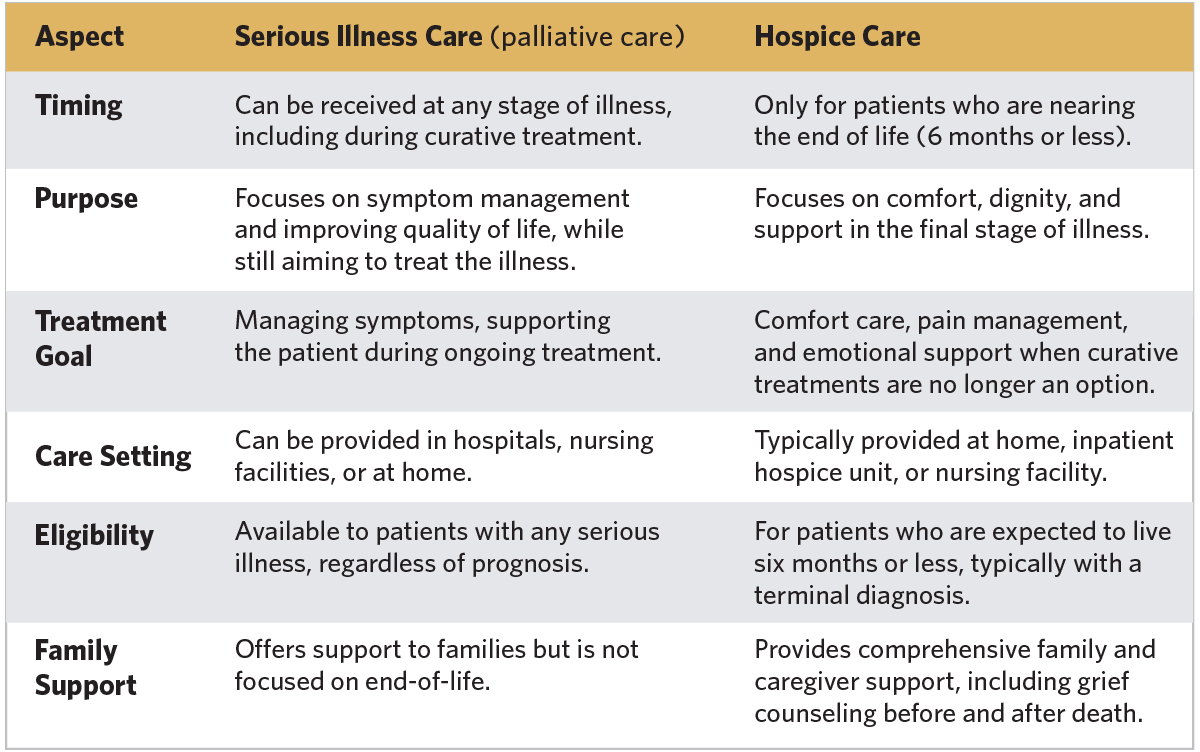
Key Differences Between Hospice and Palliative Care

Hospice Vs. Serious Illness Chart

Which Care is Right for You?

The choice between hospice and serious illness care (palliative care) depends on your loved one’s health status and goals. Serious Illness Care is a great option if you are looking for relief from symptoms but still wish to pursue curative treatment. It can be provided at any time during an illness. On the other hand, hospice care is designed for those whose focus shifts away from curing the illness and toward ensuring comfort and dignity in their final days.

Both forms of care aim to improve the patient’s quality of life, but hospice care is more focused on the end-of-life stage, while palliative care can begin earlier in a person’s illness journey. If you are unsure about which type of care is best, speak with your healthcare provider. They can guide you through your options based on your or your loved one’s specific needs. Or please call us and we can help you talk to your physician.

Understanding the difference between hospice and serious illness care can help you make an informed decision about the type of support you or your loved one needs. Whether you are seeking symptom relief during treatment or focusing on comfort and support during the final stages of life, both hospice and serious illness care are designed to ensure that patients receive the care they deserve — tailored to their individual needs and wishes.

Schedule a consultation

Contact Lightways Hospice and Serious Illness Care directly at 815.740.4104 for additional information or to schedule a consultation.

Palliative Care Proves Beneficial for Shorewood Family Dealing with Serious Illness

Palliative Care Proves Beneficial for Shorewood Family Dealing with Serious Illness

Palliative Care Proves Beneficial for Shorewood Family Dealing with Serious Illness

Don and Tania Budd of Shorewood in front of camper

A year ago October, Don Budd of Shorewood was diagnosed with pancreatic cancer. Without warning, he and his wife Tania were faced with serious decisions about his medical care and how his illness would impact their family. His life quickly became a blur of doctor visits for cancer treatment, surgery and chemotherapy.

“My family was under so much stress,” Don, 46, explains. “We were struggling to come to terms with my diagnosis. I was very ill from chemotherapy, and my wife was taking on a lot by being a caretaker, a parent to our kids and working her job as a nurse. We just didn’t know where to turn for help.”

Don’s wife of 23 years, Tania, 45, is a nurse at Silver Cross Hospital in New Lenox. Even with her expansive healthcare knowledge, they struggled to find support for their family and proper pain management for Don. Tania finally discussed her concerns with Silver Cross Palliative Care Advanced Practice Nurse Fran Flynn, R.N., B.C.-C.N.S., who oversees the inpatient palliative care team at Silver Cross Hospital. Since Don wasn’t receiving inpatient care, Flynn guided her to an community-based palliative care program available through Joliet Area Community Hospice.

What is Palliative Care?

Palliative care is specialized medical care for people living with a serious illness. Services are provided by highly trained doctors, nurses and specialists with the goal of improving the quality of life for the patient and their family.

Palliative care is appropriate at any age and stage of a serious illness, and it can be provided along with curative treatment. It addresses pain management, depression, shortness of breath, fatigue, constipation, nausea, loss of appetite, difficulty sleeping, and anxiety. Palliative care team members communicate regularly with the patient’s doctors and other healthcare workers who are providing care or therapy.
“Palliative care has been so helpful to my family and has given us hope. Don is finally getting the home nursing and pain management care needed,” Tania said. “The social worker assigned to our case has guided us to places that can give us the emotional support our family needs. We have a son and daughter, ages 21 and 24 years old, and we are concerned with how they are handling their father’s illness – the palliative care team has gone above and beyond to find them the support they need.”

Every year, nearly 1.6 million people living with a life-limiting illness receive care from hospice and palliative care providers, according to the National Hospice and Palliative Care Organization. Common diagnoses include cancer, Alzheimer’s disease, Parkinson’s disease, stroke, chronic obstructive pulmonary disease (COPD), congestive heart failure, kidney disease, amyotrophic lateral sclerosis (ALS) and more. Best of all, a recent study published in the New England Journal of Medicine has shown that patients with a serious illness, who received palliative care, lived longer than those who did not receive this care.

Palliative care benefits people who may be experiencing declines in their health, are unable to manage the daily tasks of living alone, experience intense pain on a day-to-day basis, have frequent hospital admissions or have had a prolonged length of stay in the hospital without any sign of progress.

November is National Hospice and Palliative Care Month. Silver Cross Hospital would like to raise awareness to the importance of these services and for those people coping with life-limiting illnesses. It is helpful to note that palliative care is different than hospice care. While both palliative care and hospice care provide comfort, palliative care can begin at diagnosis of a serious illness and continue through active treatment. Hospice care begins after treatment of the disease has stopped.

Palliative Care Offers Choices to Those with Serious Illness

Don said palliative care has given him the confidence to be an advocate for his own healthcare and make his own choices. An arborist by trade, Don owns a tree service company and was able to work throughout his busy season this year – doing something he loves.

“If it weren’t for the nursing and pain management services I received through palliative care, I wouldn’t have been able to do the job I love. The amazing support I have received from my healthcare team has made me realize I don’t have an expiration date. I accept that the cancer will end my life at some point. I just want to be as comfortable as I can be, doing the things I love – palliative care is giving me that chance,” said Don.

Don and Tania spent this past summer taking trips in their camper to state parks in the Midwest. In fact, he’s feeling so good he and Tania are planning a long drive to the Florida Keys.

“There’s one more thing I would like to do if it’s possible – renew my wedding vows with my wife in Las Vegas,” said Budd.

For more information, visit silvercross.org or for outpatient palliative care, visit joliethospice.org
​
About Silver Cross Hospital

Silver Cross Hospital is an independent, not-for-profit health care provider serving Will County and southwest suburban communities since 1895. Silver Cross has been recognized as a Truven Health/IBM Watson 100 Top Hospitals National Award winner for seven consecutive years, received a 5-Star rating for high quality and patient satisfaction by the Center for Medicare & Medicaid Services (CMS), and honored with an “A” Hospital Safety Grade by The Leapfrog Group. With over 4,500 employees, physicians and volunteers, Silver Cross operates a 302-bed acute care hospital and 5 satellite facilities providing outpatient services and physician offices. Silver Cross opened a state-of-the-art replacement hospital in 2012 at I-355 and Route 6 in New Lenox. In 2017, Silver Cross provided over $39 million in charity care and other community benefits. To learn more about Silver Cross Hospital or a referral to a physician on staff, visit www.silvercross.org. Physicians on Silver Cross Hospital’s Medical Staff have expertise in their areas of practice to meet the needs of patients seeking their care. These physicians are independent practitioners on the Medical Staff and are not the agents or employees of Silver Cross Hospital. They treat patients based upon their independent medical judgment and they bill patients separately for their services.

About Joliet Care Community Hospice

Joliet Area Community Hospice (JACH) is a not-for-profit, community-based, state licensed and Medicare/Medicaid certified agency serving Will, Grundy, Kendall, LaSalle, Livingston and increasing portions of Cook, DuPage, and Kankakee Counties. JACH provides quality hospice and palliative care for adults and children diagnosed with life-limiting and/or terminal illnesses. JACH is one of a handful of Illinois hospices with a dedicated Pediatric Hospice and Palliative Care Team for seriously ill children from birth to 21 years old. The 16-bed Hospice Home inpatient unit in Joliet provides care for adults and children with symptoms that cannot be managed at home and short-term respite for hospice patients whose caregivers need time away from caregiving. Since JACH’s opening in 1982, over 32,000 people have received the quality care that JACH is known for. The mission of Joliet Area Community Hospice is: Real People. Real Care. Your Family. Real knowledgeable, professional, compassionate people providing real quality care to you and your family. For more information about
Community-based palliative care, please visit lightways.org or call 1-800-360-1817.

Turning Loss & Love Into an Extraordinary Gift

Turning Loss and Love Into an Extraordinary Gift When beloved Jan died from cancer, the Lynch family turned to Lightways for support as they navigated their grief together. Months later, they found a meaningful way to honor Jan’s memory - and help other families...

read more

The Power of Connection: Stories from Integrative Therapy

When the Music Plays, Grace Wakes Up. For Grace, music has a way of reaching her. Grace has been receiving services from Lightways Hospice and Serious Illness Care since February 2023, including nursing care, supplies, and support from the Lightways Integrative Therapy team. For more than three years, a team has supported her care, focusing not only on her medical needs but also on the things that bring her comfort and joy.

read more